
Most problems in a garden show up late.
Uneven veg.
Stretch that does not line up.
Canopies that take more work than expected.
Flower that finishes inconsistently.
By the time those issues appear, the ceiling is already set.
Consistency is rarely lost in flower. It is usually lost much earlier, through small decisions that compound over time. The work that determines how predictable a run will be happens before plants ever reach their final containers.
Consistency Is Not a Mid-Run Fix
Many growers treat consistency as something to correct.
Adjust the nutrients.
Tweak the environment.
Push harder or pull back.
Those changes can manage symptoms, but they do not redesign the system. True consistency is not created through reaction. It is created through intention.
Consistent gardens are built by reducing variability early and protecting that structure as the run progresses. Once variability is introduced, the rest of the run becomes an exercise in compensation.
Mother Plants Set the Baseline
Propagation does not begin at the tray.
It begins with the mother plant.
Mother plants provide the biological starting point for everything that follows. Their health, balance, and stability influence how cuttings recover, how roots initiate, and how evenly plants establish.
When mothers are managed consistently, clones tend to behave the same way. When mothers are stressed, overworked, or uneven, clones reflect that immediately. No downstream adjustment can fully remove that upstream variability.
Cloning is not a reset button. It is a continuation of plant health.
Healthy Starts Carry Forward
Plants carry their early conditions through their entire lifecycle.
Uniform, healthy starts tend to establish roots more evenly, uptake nutrients more predictably, and tolerate transplant stress more effectively. That early stability reduces corrective work later in veg and creates tighter growth windows through flower.
Small differences at the beginning do not stay small. They scale with time.
This is why consistency compounds. When plants start close together, they tend to stay closer together.
Nutrients Support Consistency, They Do Not Create It
Clean, predictable nutrients play an important role in maintaining stability, but they are not a replacement for good process.
When early stages are inconsistent, nutrients often get blamed for problems they did not cause. Feed programs support plant health, but they cannot overwrite variability that was built in upstream.
Consistency requires alignment between plant health, disciplined process, and predictable inputs. When those elements work together, adjustments become smaller and more intentional.
Assumptions Break Repeatability
Many gardens rely on memory.
What worked last time.
What someone remembers about a strain.
What usually happens.
As teams change and time passes, that knowledge degrades. Assumptions replace data, and each run slowly drifts away from the last.
That drift is where inconsistency lives.
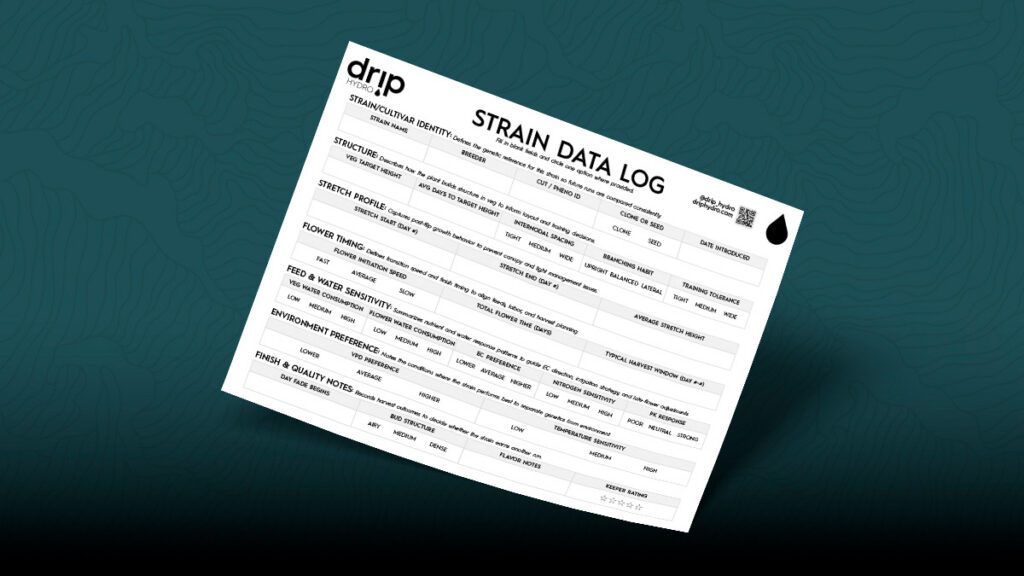
Introducing the Strain Data Log
The Strain Data Log is designed to stop that drift.
It is a single-page reference used to document how a strain consistently behaves in your garden once patterns are established. It is filled out after at least one complete run and updated only when behavior is stable.
This log is not for daily notes or troubleshooting. Its purpose is to preserve strain knowledge and remove assumptions before the next run begins.
By capturing structure, stretch behavior, timing, nutrient response, and finish characteristics, the Strain Data Log establishes a clear baseline. Future runs start from known behavior instead of guesswork.
Consistency begins with knowing what normal looks like.
Flower Execution Still Needs to Be Tracked
Once plants enter flower, execution becomes the focus.
Even with strong starts and known strain behavior, flower is where decisions around environment, feed, and timing have the greatest impact on outcomes. Without tracking, those decisions rely too heavily on memory.
This is where a flower-specific record matters.
The Role of the Run Log
The Drip Hydro Run Log is a flower-stage tracking tool.
It is designed to document what happens during flowering, where small differences in environment and feed timing have outsized effects on finish quality.
The Run Log helps capture:
- pH and EC
- Temperature, humidity, and VPD
- Feed and runoff volumes
- Stretch behavior, fade timing, and plant health observations
This allows growers to connect flower-stage decisions to final results and compare outcomes across runs more accurately.
One System, Two Tools
The Strain Data Log defines expectations before a run begins.
The Run Log documents execution during flower.
Together, they protect consistency from start to finish. One preserves genetic knowledge. The other captures flowering performance.
This separation matters. Each tool does one job clearly.
Built Early, Protected Over Time
Consistency is not about perfection.
It is about reducing variability.
Healthy mothers lead to predictable starts.
Disciplined early process reduces correction later.
Clear records prevent drift during flower.
The work done early reduces the work required later. That is the quiet advantage of building consistency from the beginning.
The most consistent gardens are not managed harder. They are designed better.