
The Variability Most Gardens Accept
Uneven rooting times.
Tray-to-tray rooting window variability, even when trays were taken on the same day.
One tray throws roots at Day 6. Another lags to Day 9. Transplant timing turns into waves instead of a clean shift.
This is not genetics. It is not luck. It is variability stacking at three control points:
- The hormonal signal at the cut
- The nutritional readiness of the media
- The discipline of execution
This launch tightens all three.
Control Point One: Define the Auxin Signal
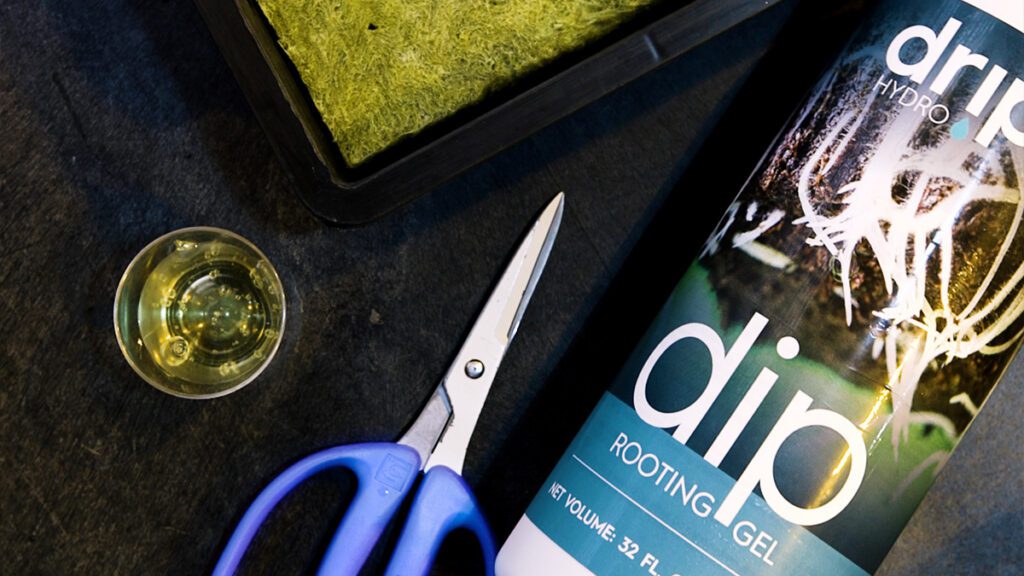
Dip Rooting Gel is formulated at 0.35% Indole-3-butyric acid (IBA), 3,500 ppm. That concentration delivers a defined auxin signal directly to fresh vascular tissue.
Auxin concentration determines how quickly cells at the wound site reorganize into root primordia. When the signal strength varies from cutting to cutting, initiation timing spreads. When initiation timing spreads, tray-to-tray rooting windows spread.
Uniform signal narrows the initiation band.
Dip integrates into commercial workflows without forcing changes:
- Direct-to-media for reduced cross-contact
- Direct-to-stem for controlled smaller batches
- Dispense-and-dip for high-throughput sessions, discarding remaining gel after use
Cuttings are never dipped directly into the bottle. Signal consistency and sanitation discipline stay intact.
Dip does one job. It tells the cutting when and where to root.
Control Point Two: Build a Metabolic Environment That Matches the Signal
Root initiation is hormonal.
Root building is metabolic.
Once the auxin signal commits the tissue to root formation, the plant immediately requires structural and metabolic support:
- Calcium for new cell wall construction
- Nitrogen for protein synthesis
- Phosphorus for ATP production
- Magnesium for early metabolic balance
- Micronutrients for enzymatic activation
Propagation media is rarely soaked in plain water. Most growers use some form of rooting solution. The issue is not whether solution is used. It is whether that solution is balanced for transition beyond propagation.
The Drip cloning protocol is built differently.
Media is pre-soaked with a balanced cloning solution that can remain consistent from root soak through early veg and into the transition toward flower without requiring abrupt nutrient shifts.
FLUIDS cloning solution
- CaMg: 2 mL per gallon
- Base A: 12 mL per gallon
- Base B: 12 mL per gallon
POWDERS cloning solution
- Powder A: 4 to 5 g per gallon
- Powder B: 4 to 5 g per gallon
- Powder D: 0.2 g per gallon
Solution is adjusted to pH 5.5 to 5.8, and media is drained to moist, not dripping.
This establishes a stable calcium-to-phosphorus environment at the stem base, supports early metabolic demand, and avoids excessive nitrogen pressure during callusing.
Signal without nutritional support stalls.
Nutrition without a defined signal drifts.
Tight propagation requires both.
Control Point Three: Lock the Workflow
Even with a defined auxin concentration and a balanced media environment, variability returns if execution drifts.
Cutting length affects hydraulic balance.
Insertion depth changes oxygen exposure.
Dome management alters transpiration stress.
Sanitation determines pathogen pressure.
Small inconsistencies compound into visible rooting spreads.
The Drip Hydro Cloning SOP standardizes:
- Mother selection and topping logic
- Cutting length of 2 to 6 inches
- Fresh 45-degree recut before gel application
- Insertion depth of 0.75 to 1 inch
- Pre-soak rates and pH targets
- Environmental targets of 70 to 80 °F, 65 to 75% RH, VPD 0.8 to 1.0 kPa
- Controlled humidity dome progression
- 30 to 50% dryback targets
- Structured re-feed timing
- Tray labeling and documentation
- Between-run sanitation using Shock
This is not paperwork. It is containment of drift.
When signal, nutrition, and execution are aligned, the rooting window compresses.
What Tight Propagation Changes Downstream
When all three control points are locked, the effects show up quickly:
- Narrower callus window
- More synchronized root emergence
- Predictable tray dry-down
- Stabilized transplant timing
- Cleaner vegetative scheduling
- Reduced downstream compression in flower
Propagation variability does not stay in the clone room. It moves into veg, then into flower, then into harvest cadence.
Tight starts scale cleaner.
This Is a System-Level Launch
This is not just a rooting gel release.
It is:
- A defined 0.35% IBA signal at the cut site
- A balanced cloning solution built to transition forward without nutrient resets
- A commercial-scale SOP that standardizes propagation from mother cut to hardening
Dip is live.
The Cloning SOP is available.
The workflow is structured.
The first 10 days set the trajectory for the entire garden.
Start controlled.