
Four Components. Four Different Jobs.
Calcium nitrate behaves differently in solution than potassium phosphate. Potassium phosphate behaves differently than magnesium sulfate. Micronutrients at trace concentration behave differently than any of them.
Separating nutrient roles into distinct components is not about adding steps. It is about letting each part of the feed run at the concentration its chemistry actually supports — instead of the concentration a shared tank can barely tolerate. In large outdoor fields and greenhouse operations where stock tanks sit between irrigation events and temperatures move across the day, that distinction is the difference between a consistent feed and a drifting one.
What Gets Shared in Simplified Systems
Most powdered nutrient systems on the market are built around two or three parts. To pull that off, they have to combine nutrient groups that would behave better separated. Here is what ends up in the same stock tank:
Calcium nitrate plus chelated micros. Some base components put calcium nitrate alongside iron EDTA, manganese EDTA, copper EDTA, zinc EDTA, boron, and molybdenum in a single concentrate. Calcium in solution at high concentration creates a high ionic-strength environment. Chelated micronutrients are more stable in lower ionic-strength solutions. Over time — especially as concentrates sit between irrigation events in heat — that environment puts pressure on the chelate bonds that keep trace elements in available form.
Dense PK salts plus micros. Some bloom or flowering components combine monopotassium phosphate, potassium sulfate, and magnesium sulfate with iron EDTA, boron, and molybdenum in the same tank. Dense PK salts approach solubility limits faster than lighter salts. When they share a concentrate with micronutrients at the same stock strength, the whole solution is being held closer to its stability boundary than it needs to be.
The uniform concentration problem. When a system runs all components at the same stock concentration — typically around 2 lb/gal regardless of what is in each tank — it is asking the densest salts to hold at a level their chemistry would not naturally prefer. The heaviest material sets the real ceiling. Everything else is either being under-concentrated or the dense component is being pushed harder than it should be.
None of this causes immediate failure. What it does is reduce the margin those stock tanks have to absorb real operating conditions — heat, extended holds, back-to-back fertigation cycles across a full outdoor or greenhouse season.
How Each POWDERS Component Is Concentrated
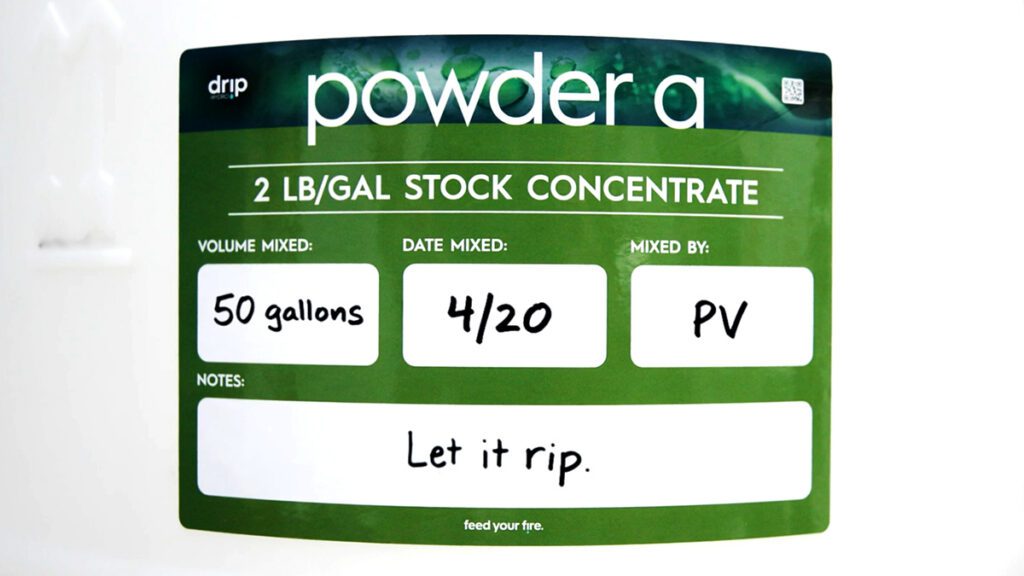
Powder A (15-0-0) — 2 lb/gal
Pure calcium nitrate. Nothing else in this tank. No micros competing in a high ionic-strength environment. Holds clean at 2 lb/gal through temperature swings and long storage. Nitrate-dominant nitrogen — stable pH, structured vegetative growth, no ammonium-driven soft tissue.
Powder B (0-7-25) — 2 lb/gal
Baseline phosphorus, potassium, magnesium, and sulfur. Separated from Powder A so phosphate never touches calcium. No micros sharing this solution either. Also runs at 2 lb/gal without precipitation risk. The 13.1% sulfur supports amino acid synthesis through stretch and sets up aromatic compound development heading into finish.
Powder C (0-32-32) — 1 lb/gal
Powder C runs at 1 lb/gal. The chemistry requires it.
At 0-32-32, that phosphorus and potassium load approaches solubility limits faster than lighter salts. Systems that run a comparable PK density at 2 lb/gal are pushing that material harder than it wants to go — especially in outdoor heat cycles and long greenhouse runs where stock tanks are not turning over quickly. At 1 lb/gal it dissolves clean, holds stable, and delivers consistently across the conditions large gardens actually run in. That is the right concentration for what this component is carrying.
Powder D — 40 g/gal
The full micronutrient trace pack in its own tank at low concentration. Chelated iron, manganese, zinc, copper, and boron are not competing with the ionic load of a calcium nitrate or dense PK concentrate. They are not being asked to stay stable inside a solution that was not designed for them. Lower concentration, dedicated tank, more stable environment. Because it runs independently, macro ratios can be adjusted mid-run without pulling the trace element supply along with it.
What This Produces Downstream
Stock tanks sit between irrigation events. In a greenhouse running three fertigation cycles a day in summer, concentrates hold for hours in heat a freshly mixed batch tank never sees. In an outdoor field they absorb whatever the season throws.
When each component runs at the concentration its chemistry supports:
- stock tanks stay stable across longer holds and temperature swings
- injector draw stays consistent across multiple daily fertigation events
- the batch tank reflects the intended recipe rather than a drift of it
- the feed dialed in is the feed that reaches the root zone, event after event
Most growers troubleshoot at the batch tank. The source is usually upstream. The POWDERS are built so that upstream stays clean.